Contents
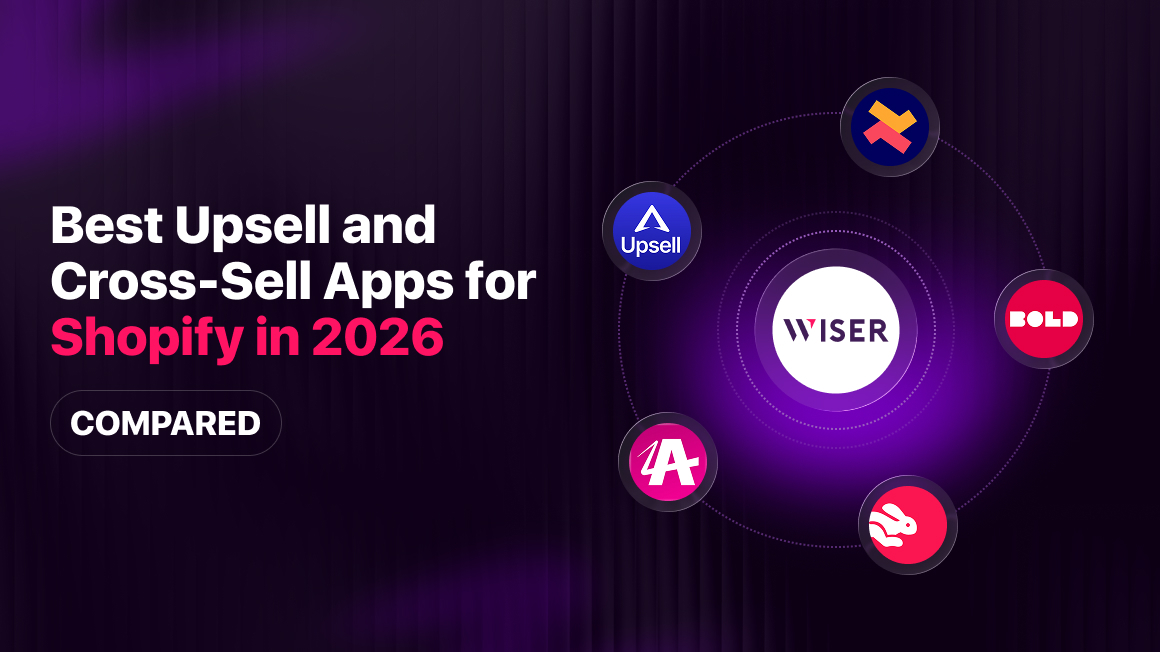
Most Shopify merchants arrive at the same point eventually: an upsell or cross-sell app starts working, the store grows past it, and a second app gets added to cover the gap the first one left behind. Then a third. Within a few months, that’s three separate subscriptions, three dashboards, and offers that occasionally compete with one another for the same customer’s attention.
Before comparing individual apps, it’s worth pausing on something people tend to conflate: upselling and cross-selling or upsell and cross-sell are two distinct techniques, and the phrase “upsell app” often obscures which one a given tool is actually built around. That distinction is where we’ll start.
Upsell vs. Cross-Sell: A Useful Distinction
Both get grouped under “AOV apps,” but they solve different problems. An upsell offers more of what the customer already wants — a larger tent, a faster laptop, a longer warranty. A cross-sell offers something different that completes the same purchase — the sleeping bags and camp stove that make the tent trip work.
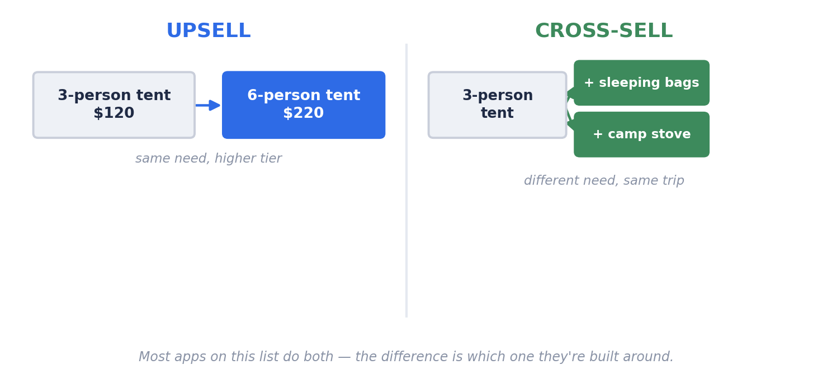
The mechanics behind each are genuinely different: upselling typically means presenting a higher-value variant at the moment of decision, while cross-selling means surfacing a relevant second product through frequently-bought-together widgets, bundles, or related-item recommendations. Many apps (upsell and cross-sell) are strong at one and only adequate at the other, and it’s worth knowing which before choosing one.
The Real Choice: A Growing Stack of Apps, or One That Covers the Journey
Merchants tend to arrive at full journey coverage one of two ways. The first is reactive: address whichever stage is under performing this quarter, and add another app the next time a gap appears. The second is to start with a single tool built to cover the full journey from the outset.
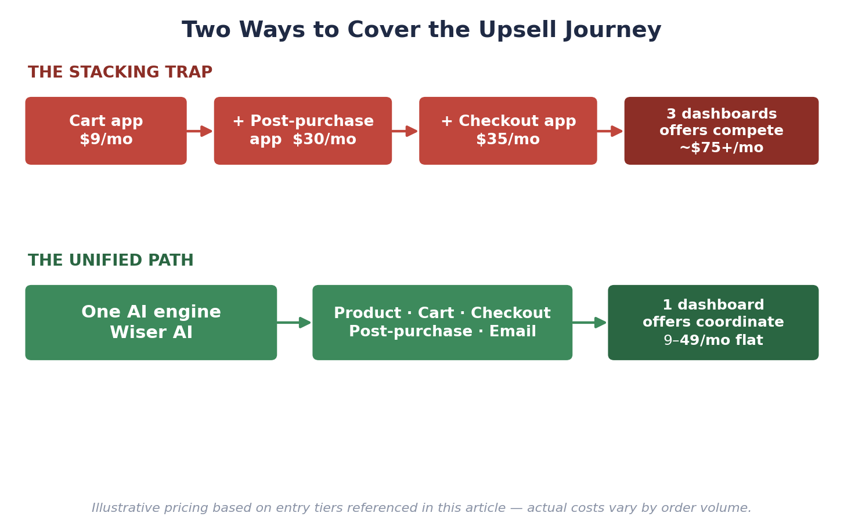
Neither approach is wrong in every case. A specialist app is a reasonable choice if only one moment genuinely needs attention. But it’s worth knowing which path a store is on before a third invoice arrives.
Which Apps Actually Cover the Full Journey
Star ratings aside, the question that determines AOV impact is simpler: at which points in the customer’s path — product page, cart, checkout, post-purchase, email — does a given app actually appear? Each gap in that lineup is revenue quietly going unclaimed.
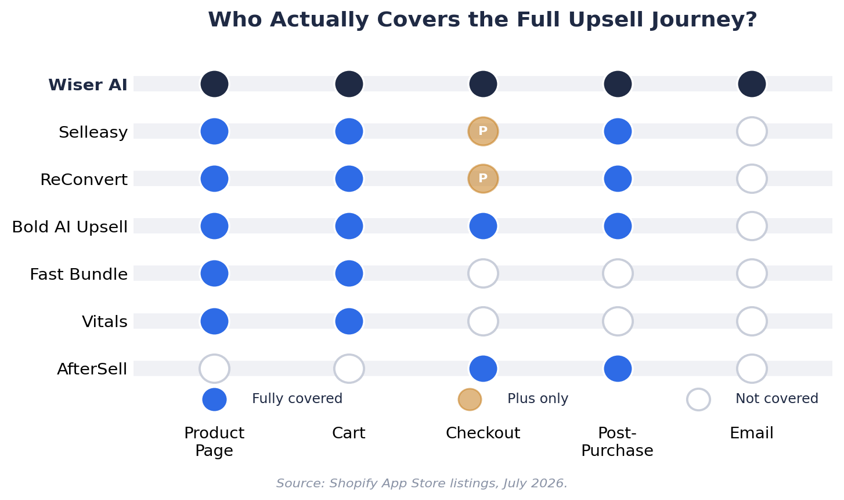
Wiser AI is the only app here with a complete row — five stages, one engine, no gaps. Selleasy, ReConvert, and Bold AI Upsell each cover four, with checkout access gated behind Shopify Plus for two of them. AfterSell trades breadth for depth, focusing entirely on checkout and post-purchase. Fast Bundle and Vitals stop at cart.
Quick Comparison Table
| App | Archetype | Starting Price | Commission? | Rating |
| Wiser AI | The Full-Funnel AI | Free / $9–$49/mo | None, ever | 4.9★ |
| Selleasy | The Free Starter | Free / $8.99/mo | None | 4.9★ |
| ReConvert | The PP Specialist | $4.99+/mo | 0.75% of upsell rev. | 4.8★ |
| AfterSell | The Plus Powerhouse | From $34.99/mo | None (flat fee) | 4.8★ |
| Fast Bundle | The Bundler | Free / $19.99/mo | None | 4.8★ |
| Bold AI Upsell | The Broad AI | $25–$500/mo | None | 4.3–4.8★ |
| Vitals | The Everything App | $29.99/mo | None | 4.6★ |
Cross-Sell Mechanics: Who’s Actually Built for It
The journey matrix above shows where an app appears. It doesn’t show whether that app is genuinely built to cross-sell well once it’s there — frequently-bought-together widgets, bundling logic, and related-product AI require different capabilities than a one-click upsell prompt, and not every app invests equally in both.
| App | Frequently Bought Together | Bundles/Mix & Match | Related Products AI | Cross-Sell in Email |
| Wiser AI | ✓✓ | ✓ | ✓✓ | ✓✓ |
| Selleasy | ✓✓ | ✓ | ✓ | – |
| ReConvert | ✓ | ✓ | ✓ | – |
| AfterSell | – | – | ✓ | – |
| Fast Bundle | ✓✓ | ✓✓ | ✓ | – |
| Bold AI Upsell | ✓ | ✓ | ✓ | – |
| Vitals | ✓ | ✓ | – | – |
Fast Bundle and Selleasy are the most cross-sell-native tools on this list — bundling and frequently-bought-together widgets are central to the product, not an added feature. Wiser AI and ReConvert both extend cross-selling into moments the bundle-first tools don’t reach, including email and post-purchase, which matters if a cross-sell strategy needs to follow the customer beyond the product page. AfterSell, by contrast, is built primarily around upselling and checkout; its cross-sell capability is worth noting but shouldn’t be the deciding factor.
Benchmarking the Top Four, Head-to-Head
Star ratings mainly confirm that an app hasn’t caused serious problems for its users. They say less about how it compares on the factors that actually determine fit. So we scored the four most-discussed apps across five dimensions that do.
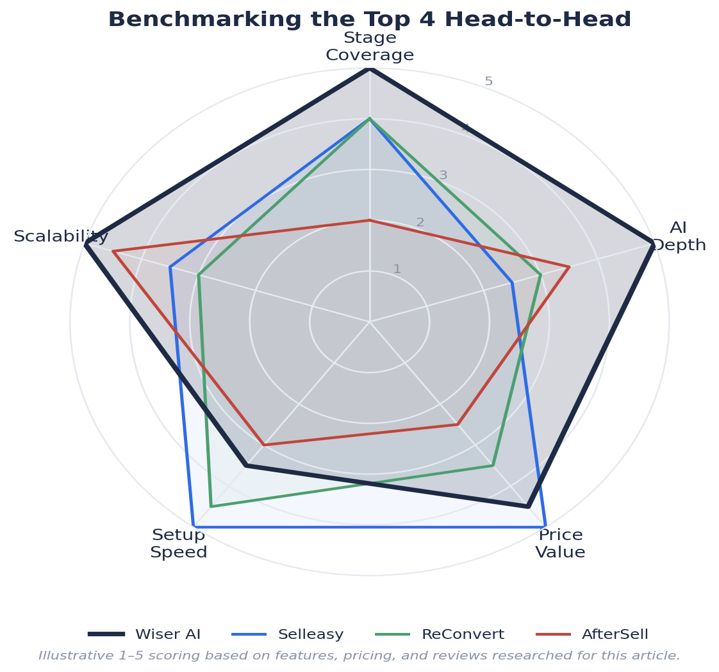
Wiser AI’s profile is the most balanced of the four — it doesn’t lead on every single axis (Selleasy sets up faster, and its free tier costs less to run at very low volume), but it’s the only one without a clear weak point. AfterSell’s profile tells its own story: narrower coverage and a higher entry price, offset by genuine scalability once a store is past the Plus threshold.
Seven Apps, Seven Roles
A flat ranked list can obscure what actually distinguishes these apps from one another. It’s more useful to think of each as filling a distinct role. Here’s each one, by the role it plays best.
THE FULL-FUNNEL AI
Wiser AI
The only app here that treats product page, cart, checkout, post-purchase, and email as one connected system rather than five separate problems. Its recommendation engine combines real-time browsing behavior with purchase-pattern data and becomes more accurate automatically as a store accumulates orders — without manual rule-building. So we can say that, it is the perfect upsell and cross-sell app.
It’s also one of the few tools here that extends cross-sell recommendations into email, not just on-site — useful for a strategy that needs to reach a customer after they’ve left the store.
- Best suited to: merchants who want a single dashboard rather than an expanding list of subscriptions
- Pricing: a free plan, then $9–$49/mo flat, with no commission regardless of upsell volume
- Worth noting: a newer entrant in this category, so its review base is still growing relative to longer-established competitors
THE FREE STARTER
Selleasy
The most accessible way to test whether upselling and cross-selling or upsell and cross-sell meaningfully improve results for a given catalog. Amazon-style “frequently bought together” widgets sit at the core of the product — genuinely one of the stronger cross-sell mechanics on this list — paired with a usable free tier and live support during setup.
- Best suited to: stores validating the concept before committing budget
- Worth noting: recommendation logic leans more rules-based than adaptive, and checkout upsells require Shopify Plus
THE POST-PURCHASE SPECIALIST
ReConvert
Built around a specific insight: the thank-you page is often underused. Its drag-and-drop editor turns that page into one-click upsells, reorder prompts, and surveys — the most refined experience for that particular moment on this list.
- Best suited to: stores that already have product-page and cart upsells in place and want to get more from checkout completion
- Worth noting: charges a commission on upsell revenue in addition to the plan fee, which becomes more noticeable above roughly 1,000 orders/month
THE PLUS POWERHOUSE
AfterSell
Prioritizes depth over breadth. Native Shopify Checkout Extensibility means offers render as part of checkout itself, rather than as a popup layered on top — supported by strong A/B testing and per-offer revenue attribution.
- Best suited to: Shopify Plus merchants at meaningful volume who need granular control specifically over the checkout moment
- Worth noting: no product page or cart coverage, so it’s rarely used as a standalone solution — and full placement coverage can exceed $100/month
THE BUNDLER
Fast Bundle
The most cross-sell-native app on this list. Bundling and AI-suggested pairings are the core product, not an added feature. Mix-and-match, volume discounts, BOGO, and Shopify POS support for merchants selling in person as well.
- Best suited to: stores where bundling, rather than individual add-on prompts, is the primary AOV strategy
- Worth noting: no post-purchase coverage — typically needs pairing with a dedicated tool for that stage
THE BROAD AI
Bold AI Upsell & Cross-Sell
Spreads AI-driven recommendations across product page, cart, checkout, and post-purchase — solid breadth at a mid-tier price point, positioned as an accessible alternative to premium full-funnel tools.
- Best suited to: stores that want wide coverage without a premium price tag
- Worth noting: review depth and AI sophistication trail the category’s more established names
THE EVERYTHING APP
Vitals
Not a dedicated upsell tool. Upselling is one of more than 40 marketing features bundled into a single subscription, alongside reviews, email capture, and other tools.
- Best suited to: very early-stage stores that want broad tooling at low cost, with plans to upgrade the upsell piece later
- Worth noting: upsell functionality is noticeably shallower than any dedicated app on this list
Find the Right Path
Rather than another checklist, here’s the decision most merchants are actually working through — mapped from where a store stands today to where it should land.
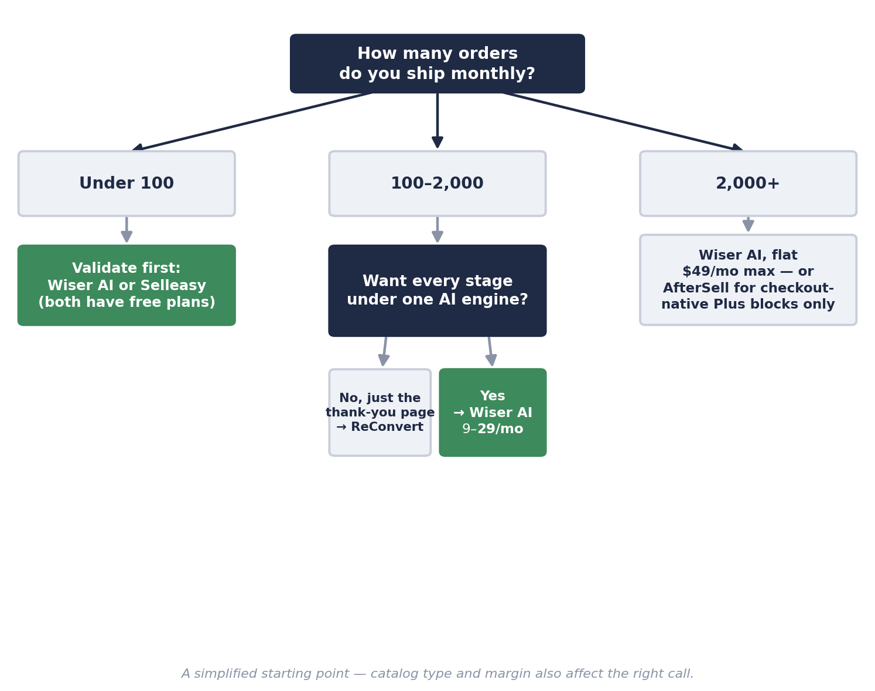
The Trade-Off Rarely Mentioned in Feature Lists
Every specialist app on this list is genuinely strong at the one thing it does. The cost of that strength is coordination — when three separate apps each decide independently what to show a customer, none of them is optimizing for the full cart, only for their own piece of it.
That’s the specific gap a full-funnel engine is designed to close: a single model deciding what a customer should see next, informed by everything known about them across every stage, rather than three models making independent guesses. It’s also why Wiser AI’s row in the journey matrix remains unbroken while most of the category has at least one gap.
FAQ
Do I need separate apps for upselling and cross-selling?
No. Every app on this list handles both. What actually matters is stage coverage — product page vs. cart vs. checkout vs. post-purchase — rather than the upsell-or-cross-sell label itself.
Is it ever reasonable to run multiple apps at once?
Occasionally — for instance, a full-journey app covering product page and cart, deliberately paired with a checkout-native specialist on Shopify Plus. The failure mode isn’t stacking apps itself; it’s stacking them by accident, one gap at a time, without a clear plan for how they interact.
Does stage coverage meaningfully affect AOV?
Yes, considerably. Cart-stage and immediate post-purchase offers convert at roughly 2–3x the rate of product-page offers in most benchmarks, since the customer has already shifted from evaluating to committing. An app that skips those stages is skipping the highest-converting moments in the funnel.
What should I prioritize when comparing these apps?
Three things, in order: which stages an app covers (the journey matrix above), how its pricing behaves at scale (flat fee vs. commission), and how much manual configuration its “AI” genuinely removes versus how much it simply relabels a rules engine.