Contents
Most post purchase upsell guides give you theory. This one gives you numbers.
Post purchase upsells are one of Shopify’s most underused revenue levers. Merchants who get it right are adding thousands of dollars every month — without extra ad spend, without new traffic, without touching their checkout. The only thing that changes is what happens in the 30 seconds after a customer says yes.
Below are 5 real examples from Shopify stores running Wiser AI. Every revenue figure is verified from merchant dashboards — not estimates, not benchmarks. Five stores, five product categories, five clear patterns you can steal for your own store.
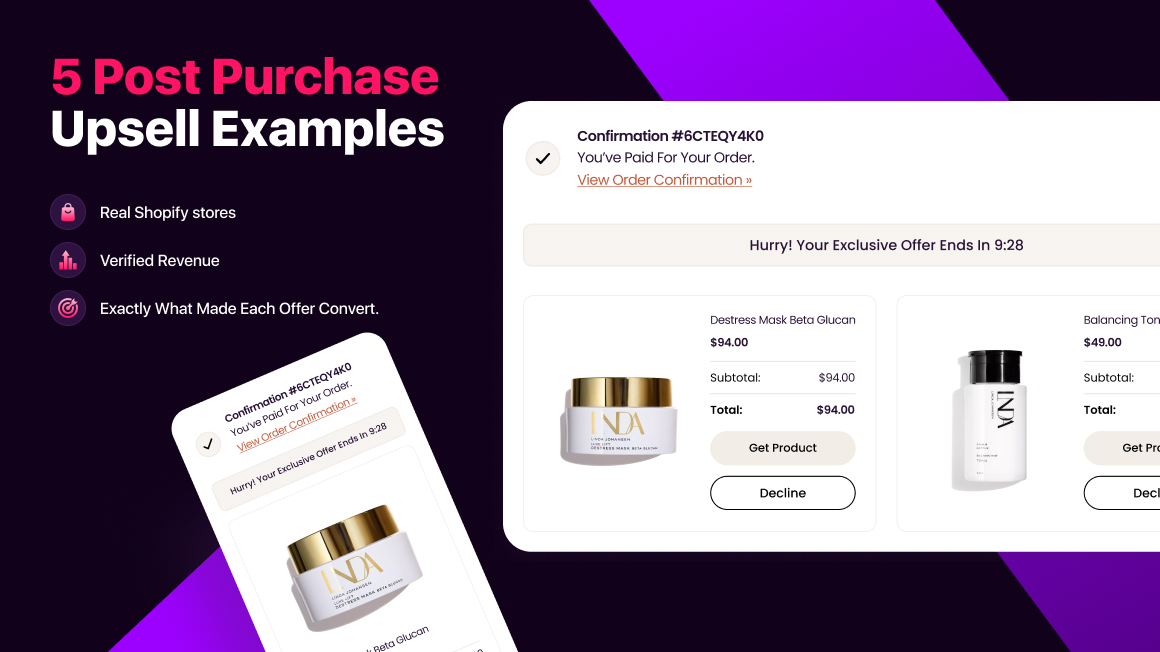
| What is a post purchase upsell? A one-click offer shown immediately after payment is confirmed — before the thank-you page. No re-entering card details. No second checkout. The original order is never at risk. One tap and the add-on is done. That zero-friction moment is why post purchase is the highest-converting upsell placement on Shopify. |
5 Post Purchase Upsell Examples — Verified Wiser Merchant Data
Every store below is a real Wiser merchant. Every number comes directly from their dashboard. No projections. No averages.
| Example 1 · Women’s Apparel · Knitwear · ★ VERIFIED WISER DATA Wooden Ships Premium hand-crafted women’s knitwear — founded 1992, Shopify Plus |
$41,833.84 in post purchase upsell revenue. 13.9% of total Wiser-generated sales of $300,081.98 — the highest post-purchase share of any merchant in this analysis.
| The Store | Wooden Ships has been selling richly coloured, hand-knitted women’s apparel since 1992. They have a loyal base of repeat buyers — women who don’t buy once and leave. They buy a cardigan, come back for the matching piece, then return again next season. Building a wardrobe, not just buying a product. That’s the customer Wooden Ships is working with. And that buying pattern is exactly why post purchase upsell works so well for them. |
| The Opportunity | A customer who just checked out with a statement knit piece has not finished shopping. She has made the first decision in an outfit. The coordinating colour, the layering piece, the matching scarf — those are already on her mind. Post purchase catches her while the vision is fresh and brand trust is at its peak. That is the window Wiser stepped into. |
| What Wiser Did | Wiser’s AI identified the highest-probability companion piece for each individual order — not a static rule, not a manual pick. Real purchase pattern data. A customer buying a rust cardigan was shown the piece most often bought with it. As inventory changed each season, the recommendations updated automatically. No manual merchandising. No stale ‘frequently bought together’ rules. |
| Why It Converted | Premium apparel customers aren’t buying products — they’re building a look. A matched companion piece at checkout doesn’t feel like an upsell. It feels like the brand reading her mind. One tap to complete the outfit is an easy yes. The post purchase moment made that feel effortless. |
| What to Avoid | Showing a piece from a different aesthetic, season, or colour story. She just committed to a look. An offer that clashes with that vision doesn’t just fail to convert — it creates a jarring moment that breaks the trust she just expressed by buying. |
| $41,833 Post-purchase upsell revenue | 13.9% Post-purchase share of Wiser revenue | $300,081 Total Wiser-generated sales |
| Example 2 · Craft Supplies · Resin Art · ★ VERIFIED WISER DATA Resin Rockers Resin art supplies, kits, pigments, and tools — resinrockers.com Shopify |
$2,000 in post purchase upsell revenue. 14.3% of total Wiser-generated sales of $14,000 — the highest post-purchase share percentage of any merchant in this analysis.
| The Store | Resin Rockers serves a tight-knit community of resin artists — from first-time hobbyists buying their starter kit to experienced creators restocking the studio. The catalogue covers everything the craft needs: resin, pigments, silicone moulds, UV lamps, release sprays, finishing tools. It’s a category where customers think in full project setups, not individual items. |
| The Opportunity | A customer buying a resin starter kit has a project in mind. They know they’ll need more supplies — they’re just not sure yet what to grab first. The post purchase moment arrives while that project is fully alive in their head and they’re still in buying mode. That’s the most receptive state a customer can be in. |
| What Wiser Did | Wiser matched each purchase to the most natural next item in the resin workflow. Starter kit buyer → pigment set or beginner mould pack. UV resin buyer → compatible UV lamp. Mould buyer → release spray or finishing polish. Simple, relevant, framed as ‘here’s what you’ll need to complete the project.’ |
| Why It Converted | Craft customers are already budgeting for the supplies they know they’ll need. A well-timed post purchase offer doesn’t ask them to spend more than planned — it saves them a return visit. One click and the shopping is done. Convenience plus relevance. That’s the formula. |
| What to Avoid | Crossing into a different craft category. A resin artist is locked in on one project. An unrelated offer breaks the mental context completely — and converts at a fraction of the rate. |
| $2,000 Post-purchase upsell revenue | 14.3% Post-purchase share of Wiser revenue | $14,000 Total Wiser-generated sales |
| Example 3 · Pet Supplies · Premium Natural Pet Food · ★ VERIFIED WISER DATA Talis US Premium natural pet food and supplies for dogs, cats, birds, reptiles — talis-us.com Shopify |
$1,587.88 in post purchase upsell revenue. 7.5% of total Wiser-generated sales of $21,133.24.
| The Store | Talis US is a family-owned pet supply store built on one belief: every pet deserves the best. Premium natural food, carefully chosen accessories, no cutting corners. Their customers aren’t bargain hunters — they’re pet owners who have made a deliberate choice to invest in their animal’s health. That emotional investment is the post purchase opportunity. |
| The Opportunity | The customer who just bought premium natural pet food has told you something important: they care deeply about their pet and they’ll pay for quality. That commitment doesn’t expire at checkout. The 30 seconds after purchase — while they’re still thinking about their pet — is when an offer framed around that animal lands best. |
| What Wiser Did | Post purchase upsells surfaced a complementary product matched to the quality standard of the original purchase — a premium treat pack, a compatible health supplement, or a grooming accessory for that specific pet type. No budget alternatives after a premium purchase. The positioning stayed consistent: here’s something else your pet will love. |
| Why It Converted | ‘Save 15%’ doesn’t move pet food buyers the way it moves other customers. ‘Give your pet a little something extra’ does. The emotional driver in this category is care, not cost. An offer framed around the animal’s wellbeing — not the customer’s wallet — converts because it speaks to the real motivation behind every purchase in this store. |
| What to Avoid | Suggesting a different food formula that implies the one they chose might not be ideal. These customers researched their decision. Introducing doubt immediately after checkout is one of the fastest ways to lose a repeat pet food buyer for good. |
| $1,587 Post-purchase upsell revenue | 7.5% Post-purchase share of Wiser revenue | $21,133 Total Wiser-generated sales |
| Example 4 · Collector’s Retail · Vintage Sewing · ★ VERIFIED WISER DATA The Singer Featherweight Shop Vintage Singer sewing machines, parts, quilting accessories — world’s leading specialist Shopify |
$10,085.98 in post purchase upsell revenue. 9.3% of total Wiser-generated sales of $108,278.55.
| The Store | The Singer Featherweight Shop is the world’s leading specialist in Singer 221 and 222 machines — iconic portables made from 1933 to 1969, still treasured by quilters and collectors globally. Every machine is individually cleaned, polished, electrically inspected, timed, and tuned before sale. The store also sells original parts, quilting accessories, period-correct attachments, handbooks, and tutorials. |
| The Opportunity | Buying a vintage Featherweight — typically $400–$900 for a fully serviced example — is not an impulse. These customers have researched, compared, and deliberated. When they finally check out, they feel a very specific kind of buyer’s satisfaction: they got the right machine. That certainty, combined with the excitement of a significant new purchase, creates unusual openness to what comes next. |
| What Wiser Did | Post purchase upsells presented the natural next step for a new Featherweight owner: a tune-up kit, original attachments (ruffler, hemmer, quilting set), an educational handbook, or a service tutorial. These weren’t invented for the upsell — they were products the customer was very likely already planning to buy. The post purchase offer just prompted that decision at the highest-trust moment. |
| Why It Converted | Featherweight buyers think in complete setups. After purchase, their mind immediately goes to accessories, maintenance, and first projects. An offer for exactly the accessories they were already planning to source isn’t a new decision — it’s an easy one they were going to make anyway, now made one click simpler. That’s the sweet spot for post purchase upsell: offers the customer already wants. |
| What to Avoid | Anything that implies the machine they just chose might not be the right one — a competing model, an upgrade, or any product framed around a limitation. Featherweight buyers chose with conviction. The upsell’s job is to serve that choice, never to question it. |
| $10,085 Post-purchase upsell revenue | 9.3% Post-purchase share of Wiser revenue | $108,278 Total Wiser-generated sales |
| Example 5 · Indian Products Marketplace · Multi-Category · ★ VERIFIED WISER DATA Distacart (Browntaped) 500,000+ Indian products — wellness, food, fashion, beauty & more — 72,000+ reviews Shopify |
$6,394.49 in post purchase upsell revenue. Generated automatically on total Wiser-attributed sales of $489,860.39. Zero extra ad spend.
| The Store | Distacart — operating as Browntaped on Shopify — is one of the largest Indian products marketplaces globally. Over 500,000 products across wellness, Ayurveda, beauty, food, fashion, baby & kids, home & kitchen, and spirituality. Himalaya, Patanjali, Dabur, Forest Essentials alongside handloom sarees, copper cookware, Indian sweets, and homeopathy products. 4.6-star rating across 72,000+ customer reviews. This is not a niche store — it’s a full marketplace. |
| The Opportunity | Most upsell strategies are built for focused catalogues. Distacart had a different problem: at 500,000 SKUs across a dozen categories, a static ‘frequently bought together’ rule cannot work. A relevant post purchase offer for a Himalaya supplement buyer looks nothing like a relevant offer for a saree buyer or someone stocking up on Indian sweets. The opportunity was to make AI recommendation work at a scale manual merchandising simply cannot reach. |
| What Wiser Did | Wiser’s collaborative filtering analysed purchase patterns across the full catalogue to find the highest-probability companion product for each transaction — automatically. Wellness buyer → complementary Ayurvedic product. Food buyer → matching condiment or snack. Saree buyer → coordinating jewellery or accessories. Category-aware matching at per-customer, per-order level. No manual input required. |
| Why It Converted | Distacart customers are not browsing randomly — they’re seeking specific Indian products that are genuinely hard to find locally. That purposeful intent makes them naturally responsive to offers that understand their context. A culturally relevant recommendation that complements what they just bought doesn’t feel like upselling. It feels like the store knowing them. |
| What to Avoid | Ignoring category context at scale. A wellness buyer doesn’t want a fashion upsell. A food buyer doesn’t want homeware. The broader the catalogue, the more important category-aware matching becomes — which is exactly what Wiser’s AI handles automatically, without any manual configuration. |
| $6,394 Post-purchase upsell revenue | $489,860 Total wiser Generated Sales | Zero Extra Ad Spend required |
What Every High-Converting Post Purchase Upsell Has in Common
Five stores. Five completely different categories. But the same four things drove conversion every time.
1. The offer completes something the customer already started
The knitwear piece finished the outfit she was already imagining. The resin supplies completed the project she was already planning. The Featherweight accessories were on the shopping list before checkout even happened. High-converting post purchase offers don’t redirect the customer — they follow where she was already going.
2. The price feels proportional
In every example, the upsell was priced at 15–50% of the original order value. That range feels like a natural add-on, not a new spending decision. Push the upsell price too close to the original purchase and you trigger a fresh evaluation — the customer steps out of buying mode, and conversion drops fast.
3. The copy leads with the customer, not the product
‘Complete your look.’ ‘Everything you need to get started.’ ‘Give your pet a little something extra.’ None of these lead with specs or features. They lead with where the customer is emotionally, right now. Post purchase customers aren’t in research mode. Meet them where they are.
4. One offer. One click. No deliberation.
Every example presents a single product with a single decision. No carousels. No ‘choose between these three.’ The one-click mechanic is powerful because it removes thinking from the equation. Add a second option and you turn a reflexive yes into a considered evaluation — conversion drops immediately.
| The Wooden Ships result in plain terms: $41,833 in additional revenue — added automatically, on every order, with no extra ads and no manual merchandising updates after initial setup. The AI matched each customer to the right offer. That’s the compounding power of getting post purchase upsell configured correctly once and letting it run. |
How Wiser AI Powers Post Purchase Upsell Across Every Category
Knitwear, craft supplies, pet food, vintage sewing machines, 500,000 SKUs of Indian goods — these stores share almost nothing in common. What they all have is Wiser’s recommendation engine identifying the right product for each individual customer at the right moment.
Wiser uses item-to-item collaborative filtering — a model trained on real purchase patterns across thousands of Shopify stores. Instead of static ‘if bought X show Y’ rules, it analyses what customers with a similar purchase history actually bought next, and surfaces the highest-probability offer for this specific customer, on this specific order, right now.
No manual rules to maintain. No seasonal updates to remember. No guesswork about which product to show. The engine handles it at a per-customer level, on every order, automatically.
See the feature: www.getwiser.ai/post-purchase-upsell-recommendations
Frequently Asked Questions — Post Purchase Upsell Examples
What is a good post purchase upsell conversion rate on Shopify?
For AI-matched one-click offers, 8–15% is a solid target for most stores. Consumable categories — coffee, supplements — where subscription offers work well can reach 18–28%. Consistently under 4%? That’s a product relevance problem. The offer isn’t close enough to what was just purchased.
Which Shopify categories see the strongest post purchase upsell results?
From the verified data in this post: craft supplies (Resin Rockers, 14.3% share) and premium apparel (Wooden Ships, 13.9%) show the highest post-purchase contribution as a percentage of Wiser revenue. Collector’s retail and pet supplies follow closely. At larger marketplace scale — like Distacart — the absolute dollar figure is meaningful but the share percentage is smaller because site-wide recommendation widgets carry more of the total Wiser contribution.
How many post purchase offers should I show at once?
One. A single relevant offer beats multi-product displays in virtually every test. Want a fallback for customers who say no? Use a downsell — a lower-priced alternative shown only after the first offer is declined. Showing two offers simultaneously doesn’t double your chances; it halves the decisiveness of the moment.
Do I need Shopify Plus to run post purchase upsells?
No. The post purchase placement — the dedicated offer screen after order confirmation, before the thank-you page — is available on all Shopify plans. All five merchants in this post used the standard post-purchase placement that works on every plan.
Should I discount my post purchase upsell offer?
Not by default. A genuinely relevant offer converts without a discount — the product match is the value. Discounts earn their place for subscription conversions (where ongoing savings justify commitment) and higher-ticket accessories where a small incentive helps. Auto-discounting everything trains customers to expect it and slowly erodes perceived product value.
How does Wiser decide which product to show as a post purchase upsell?
Item-to-item collaborative filtering. A machine learning model that identifies which products are most frequently purchased together by customers with similar buying histories. The model updates continuously from real transaction data and selects the highest-probability offer for each individual customer at the moment of purchase. No static rules. No manual overrides required.
The Takeaway From These 5 Post Purchase Upsell Examples
Post purchase upsells aren’t a growth hack. They’re what happens when you make it easy for a customer who already trusts you to say yes to one more thing.
Wooden Ships added $41,833 by showing the next piece of the outfit. Resin Rockers added $2,000 by handing craft customers the supplies they were already going to need. The Singer Featherweight Shop added $10,085 from accessories every new machine owner wants. None of it needed extra traffic, extra creative, or ongoing manual effort after setup.
The revenue was already there. It just needed the right offer, at the right moment, with zero friction. That’s what a well-configured post purchase upsell does. Every order. Every day. Without you having to think about it.
| Add post purchase upsell to your Shopify store Wiser AI works on all Shopify plans. 14-day free trial. No code required. Setup in minutes. www.getwiser.ai/book-a-demo |