Contents
Why Upselling is the Most Underused Revenue Strategy in Shopify
Most Shopify store owners spend the majority of their time and budget on acquiring new customers — running ads, optimizing SEO, posting on social media. And yet one of the highest-ROI strategies available sits largely untouched: getting the customers already in your store to spend a little more.
That’s upselling. And the numbers behind it are hard to ignore.
The reason most stores don’t capture this revenue isn’t laziness — it’s confusion. There are dozens of upsell apps for Shopify, they all make similar claims, and the differences between them aren’t obvious until you’ve actually installed them and run live offers.
We did that. We tested every app on this list on real Shopify stores, read through 500+ verified merchant reviews, and evaluated each app against three criteria that actually matter: how relevant the offers can be made, how many customer journey stages are covered, and how easy it is for a non-technical merchant to get results quickly.
Here’s what we found.
The Shopify Upsell Window and Why It Changes Everything
Before you choose an app, you need to understand the single most important concept in upselling: the conversion window.
When a customer clicks “Add to Cart,” something shifts in their psychology. They’ve made a decision. They’re in buying mode. The mental resistance that makes most people ignore advertisements has dropped — because they’re already buying. This window lasts roughly 60 seconds at peak, and then it closes.
Apps that catch customers in that window with a relevant offer convert at 15–25%. Apps that miss it — or show a generic offer at the wrong time — convert at 3–5%. That’s a 5–8x difference in revenue from the exact same traffic.
For a deeper knowledge about customers behaviour read the article, From Click to Cart – understanding customer E-commerce Journey
This is why which stages an app covers matters more than almost anything else. An app that only handles post-purchase upsells is leaving the cart-stage window completely untouched. An app that only works on product pages may be showing offers too early — before the customer has committed to buying anything.
Keep this in mind as you read through the reviews below.
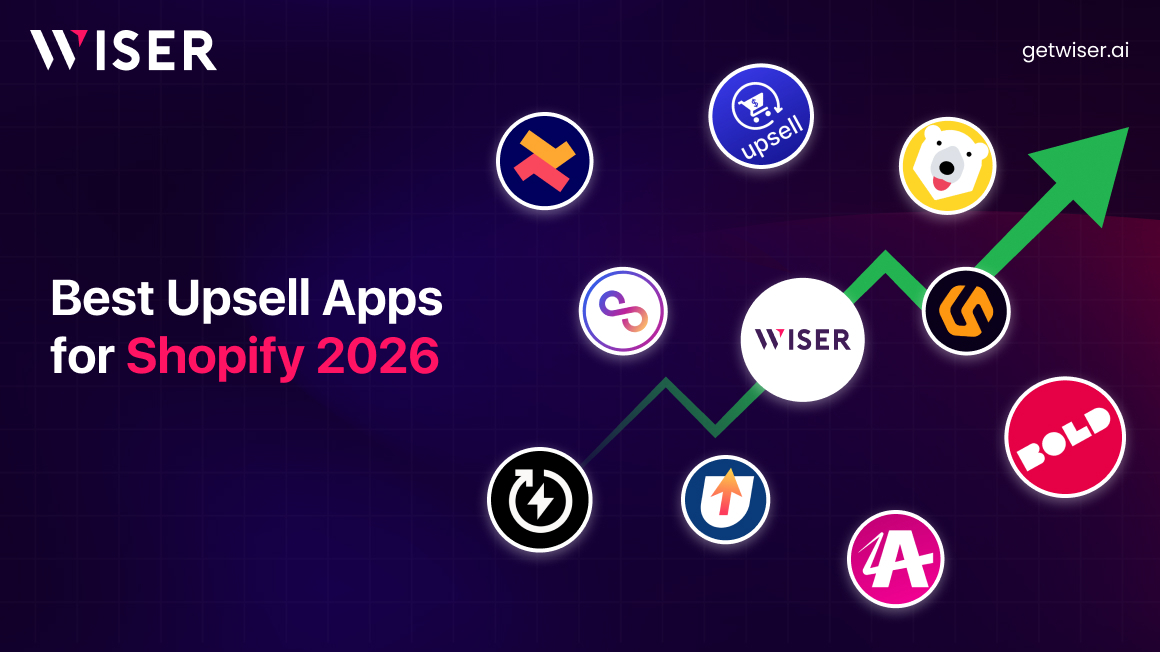
Best Shopify Upsell Apps in 2026 At a Glance
| Best Shopify Upsell Apps | Rating | Reviews | Free plan? | Pricing | Customer Journey Stages | AI? |
|---|---|---|---|---|---|---|
| WISER | 4.9★ | 497 | Yes | Free / $9–$49/mo | 5 / 5 | Multi-signal ML |
| Selleasy | 4.9★ | 2,199 | Yes | Free / $8.99/mo | 4 / 5 | Basic AI |
| Essential Upsell | 5.0★ | ~2,000 | Yes | Free / $9.99/mo | 2 / 5 | Manual |
| ReConvert | 4.8★ | 2,836 | Trial | $4.99+/mo + 0.75% | 4 / 5 | AI + manual |
| Aftersell | 4.8★ | 778 | Yes | $34.99–$99/mo | 2 / 5 | Smart targeting |
| Rebuy | 4.8★ | 500+ | No | $99–$749+/mo | 4 / 5 | Advanced ML |
| Honeycomb | 4.8★ | 600+ | Yes | Free / $49.99/mo | 3 / 5 | AI + manual |
| Zipify OCU | 4.5★ | 495 | No | $8+/mo + rev share | 3 / 5 | Basic AI |
| Bold Upsell | 4.3★ | 1,500+ | Yes | $25–$500/mo | 4 / 5 | Optional |
| Limespot | 4.5★ | 1,600+ | No | $6.99–$50+/mo | 3 / 5 | Behavioral AI |
Detailed Review – Best Upsell Apps For Shopify Stores
WISER — AI-Powered Upsells & Recommendations
WISER stands apart from every other app on this list in one specific way: it is the only app that covers all five customer journey stages — product page, cart, checkout, post-purchase, and email — through a single unified AI engine. Every other full-journey app either misses one or two stages, or is priced at the enterprise level ($99+/month).
The AI architecture is also meaningfully different from most apps that claim AI. Where most tools use basic co-purchase analysis (“customers who bought X also bought Y”), WISER’s AI powered recommendation engine works across three simultaneous layers: real-time Shopper Signals, Behavior Intelligence, and Product Intelligence — blended by an AI Recommendation Brain that improves with every order your store processes.
You might like to know the best shopify product bundle apps to increase sales this year.
Selleasy — Upsell & Cross Sell
Selleasy is the most widely installed upsell app on Shopify, active on over 42,000 stores with 2,199 reviews at 4.9 stars. Those numbers reflect one thing: it consistently works for a very wide range of store types. Its core strength is replicating the Amazon “Frequently Bought Together” experience — showing complementary products alongside the main item, letting customers add multiple items at once before checking out.
Checkout the list of Best post-purchase Upsell Apps for shopify Stores to increase AOV and conversions.
Try these 7 product bundling strategies on your Shopify Stores for best conversion results.
Essential Upsell & Cross Sell
A perfect 5.0 star rating across nearly 2,000 reviews is the rarest thing on the Shopify App Store. It means that across thousands of merchants — every store size, every catalog type, every Shopify theme — this app has not accumulated enough negative experiences to pull the rating below perfect. That’s a meaningful signal about reliability and consistency.
Essential Upsell is built around radical simplicity. It does two things — product page and cart upsells — and it does them through a visual drag-and-drop editor that most merchants have live in under 30 minutes, with zero technical knowledge required. It is backed by Essential Apps, whose portfolio powers over 200,000 Shopify stores.
Read in detail about the best upsell apps for Shopify to increase average order value.
ReConvert — Upsell & Cross Sell
Most Shopify stores treat the thank-you page as a receipt — order confirmed, see you next time. ReConvert’s entire premise is that this is a missed opportunity. With 2,836 reviews at 4.8 stars across 13,905 stores, merchants have validated that premise at scale.
The insight is sound: immediately after placing an order, customers are at their highest point of satisfaction and lowest point of resistance. ReConvert turns that moment into a revenue opportunity with a fully customizable thank-you page that includes one-click upsell offers, countdown timers, birthday collectors, surveys, and reorder widgets.
Aftersell Post Purchase Upsell
Aftersell solves the one problem that high-volume merchants have with ReConvert: the 0.75% commission model that makes costs unpredictable as upsell revenue grows. Aftersell charges a flat monthly fee regardless of how much upsell revenue it generates — meaning the better your upsells perform, the better the ROI on your app spend.
For Shopify Plus merchants, Aftersell has a technical advantage worth noting: it uses native Shopify Checkout Extensibility blocks, meaning checkout upsell offers are embedded as a native part of Shopify’s checkout page rather than as a popup or overlay. This matters both for conversion (native elements convert better than overlays) and for Shopify’s checkout consistency guarantees.
Rebuy Personalization Engine
Rebuy is what enterprise-grade AI personalization looks like for Shopify. For large stores with 10,000+ products, multiple international markets, complex customer segmentation, and a development team — Rebuy’s recommendation engine is genuinely powerful and hard to replicate at this level of sophistication.
The honest caveat: Rebuy starts at $99/month, requires developer involvement for full configuration, and multiple merchant reviews note that meaningful ROI takes 3–6 months as the AI learns the catalog. It is built for a specific tier of operation — and for merchants outside that tier, the price-to-value ratio is difficult to justify.
Honeycomb Upsell & Cross Sell
Honeycomb occupies a useful middle ground in this market: it covers product page, cart, and post-purchase upsells, offers both AI autopilot and manual configuration, and has a genuine free plan. For a store that wants multi-stage coverage without committing to a premium platform, it is a reliable and well-regarded option.
Zipify OneClickUpsell (OCU)
Zipify was built by Ezra Firestone’s team at Smart Marketer specifically for DTC brands running the paid-traffic-first playbook. The entry pricing starts lower than it might appear — $8/month for the base plan, scaling via revenue share — making it accessible for testing. The core product is one-click upsell funnel sequencing, designed to maximize revenue from every customer already in your paid acquisition funnel.
Bold Upsell
Bold Upsell has been a fixture in the Shopify app ecosystem since the platform’s early days. Its 1,500+ reviews accumulated over years reflects consistent performance — and the 4.3 star rating is the most honest signal on this list that it hasn’t kept pace with newer competitors in terms of AI sophistication and interface quality.
Bold Upsell’s strength is manual control. You define precisely which products trigger which upsell offers, under which conditions. For enterprise operations with specific merchandising requirements — “always upsell product X with product Y for B2B customers, never for retail” — this level of manual specificity can outperform AI that might optimize differently.
Limespot Personalizer
Limespot is not primarily a upsell app — it is a full behavioral personalization platform that includes upsells as one component of a much broader feature set. A/B testing across placements, dynamic layouts that reorder based on individual browsing behavior, SMS recommendations, and email personalization are all part of the platform.
For large Shopify stores with dedicated eCommerce teams that need complete site-wide personalization — not just upsell widgets — this breadth is genuinely valuable. For merchants primarily looking to improve upsell revenue, the added complexity and cost are difficult to justify when more focused tools deliver better ROI with less effort.
Which Apps Cover Which Upsell Stages
Not all upsell apps cover the same customer journey touchpoints. This matters significantly — an app that only handles post-purchase misses the cart stage entirely, which is consistently the highest-converting upsell moment.
| App | Product page | Cart | Checkout | Post-purchase | Score | |
|---|---|---|---|---|---|---|
| WISER | ✓ | ✓ | ✓ | ✓ | ✓ | 5/5 |
| Selleasy | ✓ | ✓ | Plus | ✓ | — | 4/5 |
| ReConvert | ✓ | ✓ | Plus | ✓ | — | 4/5 |
| Rebuy | ✓ | ✓ | ✓ | ✓ | — | 4/5 |
| Bold Upsell | ✓ | ✓ | ✓ | ✓ | — | 4/5 |
| Honeycomb | ✓ | ✓ | — | ✓ | — | 3/5 |
| Zipify OCU | — | ✓ | ✓ | ✓ | — | 3/5 |
| Limespot | ✓ | ✓ | — | — | ✓ | 3/5 |
| Essential Upsell | ✓ | ✓ | — | — | — | 2/5 |
| Aftersell | — | — | ✓ | ✓ | — | 2/5 |
Here is the list of 15 best Shopify Apps to increase sales in 2026.
How to Choose the Right App for Your Store
The right upsell app depends on three things: where your store is in its growth journey, which customer journey stages you want to cover, and how much you want to pay.
Just starting out (0–100 orders/month): Validate the concept first. Start with Essential Upsell (free, live in 30 minutes) or Selleasy (free, most proven). Both will tell you within two weeks whether upselling converts for your catalog. No risk, no cost.
Growing store (100–2,000 orders/month): You need AI, and you need it to cover more than one stage. WISER covers all five stages at $9–$29/month with a free plan. Honeycomb covers three stages for a similar price. ReConvert excels specifically at post-purchase.
Scaling store (2,000–10,000 orders/month): Commission-based pricing starts to hurt at this volume. Aftersell’s flat fee becomes more cost-effective than ReConvert’s commission. WISER scales to $49/month maximum — flat pricing regardless of order volume.
Enterprise / Shopify Plus: Rebuy for large catalog AI personalization. Aftersell for native checkout upsells. Limespot if you need full site-wide personalization beyond upsells.
Calculate Your Potential Upsell Revenue
Use this calculator to estimate how much additional monthly revenue a well-configured upsell strategy could generate for your specific store numbers.
Checkout, 7 proven upsell strategies powered by personalization tools.
5 Rules for Upsells That Convert — Not Ones That Annoy
The app is half the equation. Configuration is the other half. These five rules separate merchants who see 20%+ AOV lifts from those who install an app and see nothing.
1. Relevance above all else. The offer needs to feel like a natural complement to what the customer is buying — not a random bestseller. If someone’s buying a coffee grinder, show a coffee subscription or a set of filters, not a mug that happens to sell well. The moment an offer feels arbitrary, it converts at 3–5%. When it feels obvious, it converts at 15–25%.
2. One or two offers — not five. Showing three or more upsell offers at once consistently reduces conversion rates in testing. Decision fatigue is real. Choose your strongest one or two pairings per product and present them clearly. The merchants with the highest acceptance rates almost always have fewer offers than you’d expect, not more.
3. Remove every step of friction. One-click acceptance is not a nice-to-have — it’s the difference between 12% acceptance and 4%. Every extra page, every payment re-entry, every “are you sure?” confirmation is a conversion killer. The best upsell apps know this and design for zero friction.
4. Timing beats creativity. Cart-stage upsells and immediate post-purchase upsells consistently outperform product page upsells by 2–3x. The customer’s mental state at those moments — committed to spending, satisfaction at its peak — is fundamentally different from the evaluative mindset on a product page.
Read how cart drawer upsell and checkout upsell boost OV by 25%.
5. Review performance every 30 days. Cut any offer below 3% acceptance after a 30-day trial. Double down on anything above 10%. The compounding effect of eliminating poor performers and scaling winners is the difference between a 10% and a 25% AOV lift over six months.
Frequently Asked Questions
Final Recommendations — By Store Situation
After independently testing all ten apps and reviewing 500+ merchant ratings, here is our honest recommendation for each store situation.
This review was conducted independently. We tested each app on Shopify test stores and analysed 500+ verified merchant reviews from the Shopify App Store. All ratings and review counts are verified from the Shopify App Store as of March 2026. Pricing may change — always confirm current pricing on each app’s official listing page.